
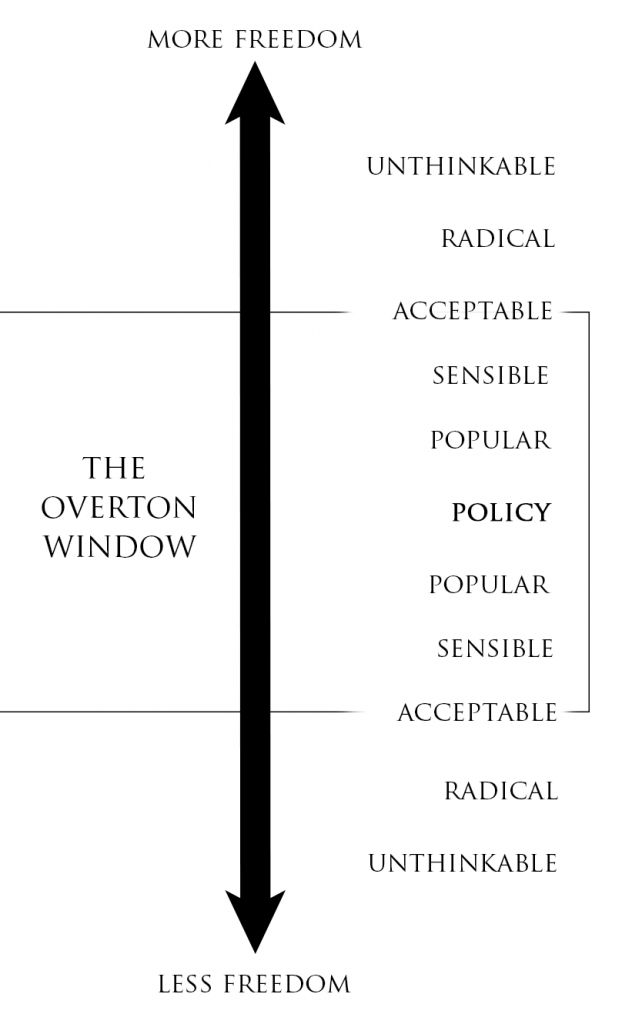
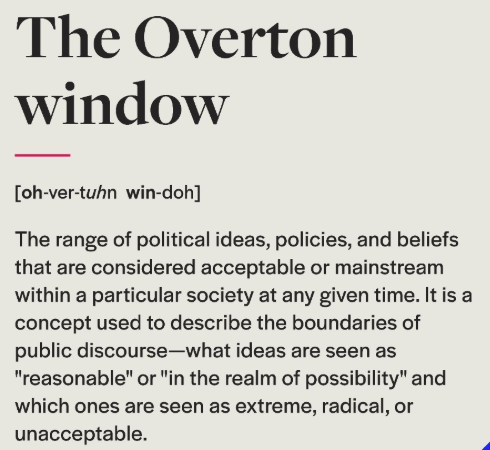
I came across an idea recently called the Overton Window. The concept itself isn’t particularly complicated. It basically describes the range of ideas that a society considers acceptable at a certain point in time. Some things are completely outside the window. Some are controversial but discussable. Others are so ordinary that nobody even thinks about questioning them anymore.
What caught my attention wasn’t really the political theory behind it. It was the idea that the window moves. Something can be considered unacceptable today, become discussable tomorrow, tolerated later, and eventually become so ordinary that people forget it was ever controversial. That thought has been bothering me. Because if the window can move, then it can move in either direction. And what happens when we don’t notice where it’s going?
We Don’t Always Notice When the World Changes
When people talk about changing social norms, they usually make it sound like progress. Something that used to be rejected becomes accepted. Something people were afraid to talk about becomes something they can finally discuss. Society becomes more open. Sometimes, that’s probably true. But I don’t think everything becoming acceptable automatically means society is becoming better.
A society can normalize empathy. It can also normalize cruelty. It can become more comfortable questioning authority, or it can become more comfortable obeying it. It can become more open to difficult conversations, or it can become so used to something disturbing that nobody bothers having the conversation anymore.
The Overton Window doesn’t tell us whether the direction is good or bad. It only tells us that the boundary exists, and that the boundary can move. That’s the part I find unsettling. Nobody stands in the middle of society and announces, “Alright, everyone. Today we’re moving the line.” It doesn’t happen like that. A joke gets repeated. Something uncomfortable gets ignored. Someone crosses a boundary and nobody says anything. Then it happens again. Eventually, someone says, “That’s just how things are.” And somehow, that’s enough. The window moves. We move with it. Most of the time, we probably don’t even notice.
How Did We Get So Good at Calling Things Normal?
That’s what made me think about the recent developments surrounding the Cornell University sexual assault case. The case itself dates back to 2024, but it returned to public attention in 2026 after a civil lawsuit brought renewed scrutiny to the allegations and the way the original investigation was handled. The criminal investigation was reopened in September 2026, and New York Governor Kathy Hochul later appointed Attorney General Letitia James as special prosecutor. Cornell has also agreed to an external review.
I’m not interested in rewriting the news here. There are already plenty of articles doing that, and the legal process is still developing. I also don’t want to pretend that I know exactly what happened when the investigation itself isn’t finished. What interests me is something much more uncomfortable: how does someone become comfortable with something they shouldn’t be comfortable with? How does something obviously wrong slowly become something people can explain away? And perhaps more importantly, how does a group make that process easier?
The Human Mind Has an Incredible Talent for Excuses
I’ve been thinking about this for a while: humans don’t always need someone else to deceive them. We can do it ourselves.
The mind is incredibly good at protecting its own version of reality. Give it something uncomfortable and it will look for an explanation. Give it something wrong and it will look for an excuse. Give it a contradiction and it will sometimes find a way to make both sides feel true. That’s probably one of the strangest things about being human. We don’t just experience things. We interpret them. And sometimes, we interpret them in a way that allows us to keep thinking we’re the good person.
That’s where normalization becomes dangerous. Something doesn’t become normal because it is good. Sometimes it becomes normal because people get tired of calling it wrong.

Everyone Does It
There is a sentence humans have probably used to justify more things than they would like to admit: “Everyone does it.” It sounds harmless. It isn’t.
Because the moment something becomes common enough, we stop asking whether it is right and start asking why anyone would still complain about it. That’s a completely different question. If enough people laugh at something, eventually the person who doesn’t laugh becomes the strange one. If enough people ignore something, the person who points it out becomes annoying. If enough people participate in something, questioning it starts to look like overreacting.
And suddenly, the person questioning the behavior is the one who has to explain themselves. That’s how social pressure works. It doesn’t always tell you that something is good. Sometimes it just makes being against it uncomfortable enough that you eventually stop being against it. And I think that’s much more dangerous.
People Don’t Always Notice When They Become Different
Nobody wakes up one morning and thinks, Today I’m going to become comfortable with something I used to think was wrong. It happens gradually. A joke here. Silence there. A little compromise. Another excuse. Another person doing the same thing. Another person deciding it’s not their problem.
Eventually, the thing that once bothered you doesn’t bother you anymore. You don’t even remember when that happened. Maybe that’s how people lose their boundaries. Not because someone suddenly destroyed them, but because they kept moving them a few centimeters at a time.
And that’s where the Overton Window starts feeling less like a political concept and more like something psychological. The window moves. Then your standards move. Then your memory of where the old boundary was starts disappearing.

When a Person Becomes a Case
Then there is the institutional side of all this. This part has always felt strange to me. Something happens to a person, and the moment it enters an institution, the language changes. A person becomes a complainant. A story becomes a statement. A statement becomes evidence. Evidence becomes a case. A case becomes a procedure.
Suddenly, everything is about policies, jurisdiction, disciplinary processes, legal standards, documentation, and timelines. And yes, all of that matters. Serious accusations need evidence. Investigations need procedures. People accused of crimes have rights. Nobody should be convicted simply because a story sounds convincing.
But there is still something uncomfortable about watching a human experience slowly disappear underneath institutional language. A person experienced something. The system asks whether it can prove it. Those are two completely different realities.
In Cornell’s case, the 2026 reopening has also brought renewed scrutiny to the university’s handling of the original matter. Cornell previously conducted an internal disciplinary process that resulted in sanctions against several students, and the university has now agreed to an external review.
I don’t think I can sit here and declare who is right or wrong from a laptop. But I can watch what happens when a human story enters a system. And sometimes, that is already revealing.

What Does a University Actually Know How to Fix?
This is where my thoughts become a little more cynical. Universities are supposed to teach people how to think. Question assumptions. Challenge ideas. Understand ethics. Think critically. But universities are also institutions.
Institutions like things they can measure. They like rules. They like forms. They like procedures. They like things that can be written down, investigated, categorized, and eventually marked as resolved.
Cornell has made significant efforts to address campus sexual assault, including a task force whose 2026 recommendations covered prevention, education, reporting, community culture, and institutional accountability. So I don’t think the answer is simply, “Cornell doesn’t care.” That’s too easy.
The harder question is whether an institution can actually fix a culture. Because writing a policy is one thing. Changing people is another.
You can write a rule telling people to respect consent. You can organize training. You can create reporting systems. You can establish committees. You can publish statements. But you cannot write a paragraph that prevents someone from convincing themselves that something deeply wrong is somehow acceptable. That part happens inside the person. And that’s probably the one place an institution has the least control over.
And Somehow, ChatGPT Is Easier
Which brings me to something that I find almost funny. We live in a time when AI can write essays, generate code, summarize books, create images, answer questions, and basically sit beside a student while they pretend they are still doing everything themselves.
And universities can actually do something about that.
A student uses ChatGPT. There is a policy. There is a violation. There is a procedure. Everyone knows what happened. It fits neatly inside the machine.
I’m not saying academic integrity doesn’t matter. It obviously does. I’m saying that compared to human behavior, ChatGPT is almost refreshingly simple.
A machine doesn’t have childhood experiences, social pressure, ego, friendship, fear, shame, reputation, or the desperate need to fit into a group. People do.
You can detect an AI-generated essay. Good luck detecting the exact moment when a group of people collectively decides that something wrong isn’t worth questioning anymore.
You can punish someone for breaking a written rule. Good luck writing a rule against moral indifference.
And maybe that’s why institutions sometimes look so much more competent when dealing with problems that have clear definitions. A policy violation has a timestamp. A change in someone’s moral boundaries doesn’t.

Maybe We Are More Afraid of Being Different Than Being Wrong
I’ve always found this part of human behavior interesting. Sometimes people don’t defend something because they genuinely believe it. They defend it because admitting they were wrong would be embarrassing. So they change the story instead.
Maybe it wasn’t that serious. Maybe everyone misunderstood. Maybe that’s just how things are. Maybe it’s normal.
That word again.
Normal.
We use it like it means something is automatically acceptable. It doesn’t. Normal doesn’t mean good. Normal doesn’t mean harmless. Normal doesn’t even mean morally acceptable. It just means we have seen something enough times that it no longer surprises us.
And maybe that is one of the most dangerous things about familiarity. It can make almost anything feel harmless.
The Window Can Move in the Wrong Direction
This is probably the part of the Overton Window that interests me the most. We often assume that if the boundaries of society are changing, the change must be progress.
I’m not convinced.
A window can move in the wrong direction. A society can become more accepting of people who were previously excluded. That’s good. But a society can also become more tolerant of things that should never have become tolerable.
It can normalize empathy. It can normalize cruelty. It can normalize curiosity. It can normalize indifference. It can normalize questioning. It can normalize silence.
The fact that something eventually enters the window doesn’t mean it deserved to.
That’s why I think we should be careful with the word normal. Maybe the question shouldn’t always be, “Is this normal now?” Maybe sometimes it should be, “Why did this become normal?” And perhaps even more uncomfortable: “Should it have?”

The Part That Actually Scares Me
I don’t think the scariest thing about cases like this is simply that people are capable of doing terrible things. We already know that. Human history has made that painfully obvious.
What scares me more is how easily people can learn to live around terrible things. How quickly something becomes a joke. How easily a group protects its own image. How comfortable silence can become. How the human mind can manufacture an explanation for almost anything if accepting the truth would make life more uncomfortable.
Maybe that’s why I’ve been thinking about this so much. I don’t think being a decent person is simply about knowing the difference between right and wrong. Maybe it’s also about noticing when your definition of normal starts moving.
Because perhaps the most dangerous thing isn’t crossing a boundary. Maybe it’s forgetting that there was ever a boundary there at all.

Maybe We Should Stop Trusting the Word “Normal”
I don’t know what the final outcome of the Cornell investigation will be. I don’t think anyone should pretend to know before the process is finished.
But the question underneath it stays with me. How many things do we accept because we’ve simply seen them too many times? How many opinions do we defend because changing our minds would hurt our pride? How many times do we stay silent because speaking up would make us the strange person in the room? And how often do we confuse “everyone does it” with “there is nothing wrong with it”?
Maybe the human mind isn’t only capable of understanding reality. Maybe it’s also capable of protecting us from understanding it too clearly.
That’s what I find disturbing.
We like to imagine that evil looks obvious. Sometimes it probably doesn’t. Sometimes it looks like a joke everyone laughs at. Sometimes it looks like silence. Sometimes it looks like a group convincing itself that everything is fine. Sometimes it looks like an institution following its procedures while everyone outside is wondering whether the procedures were enough.
And sometimes, apparently, it looks like a university spending an impressive amount of energy figuring out what students are doing with ChatGPT.
Maybe the question isn’t whether something is normal. Maybe the question is why we became comfortable with it.
And if the window really does move when nobody is looking, maybe we should occasionally stop and look at where it is now.
I don’t think I have a perfect answer. But I’m starting to think that normal is a word we should trust a little less.